
How to De-risk Your Product Delivery (And Actually Ship on Time)
Why the messy work you avoid before building is exactly what kills your roadmap

Most roadmaps die because of things we are too afraid to dig into early.
We don't miss delivery deadlines because we’re slow; we miss them because we’re optimistic about things we don’t understand.
We spend extra time polishing the tidy parts of our solution because hiding in the known feels safer than confronting the mess.
This is a failure of risk management. Shaping a solution well is, at its core, managing that risk.
Why I Think About Risk Differently
My background is in engineering and insurance risk modelling. In those worlds, you learn quickly that it isn’t the expected outcome that destroys you—it’s the tail risk.
The tail risk is the low-probability, high-impact event that nobody planned for because it seemed unlikely.
In insurance, you don’t model for a normal day. You model for the Black Swan: the 100-year flood that arrives twice in one decade, or the freak disaster that wipes out an entire portfolio overnight.
Here’s what most people miss: software delivery has a remarkably similar risk curve with respect to time.
Your 6-week estimate assumes a “normal distribution” of work. You assume familiar tech, known integrations, and no surprises. That’s the "expected" outcome—and in the real world, it almost never happens.
What actually happens lives in the Tail:
The third-party API that doesn’t behave like the documentation promised.
The data migration that uncovers years of inconsistency.
The “simple” authentication change that touches every service in the stack.
But unlike insurance, software teams have a superpower: we can actually reduce that risk at the source.
You just have to be willing to dig into the mess while you are still shaping the solution—not after you’ve already committed the team to a build cycle.
The Mental Model: Thinning the Tail
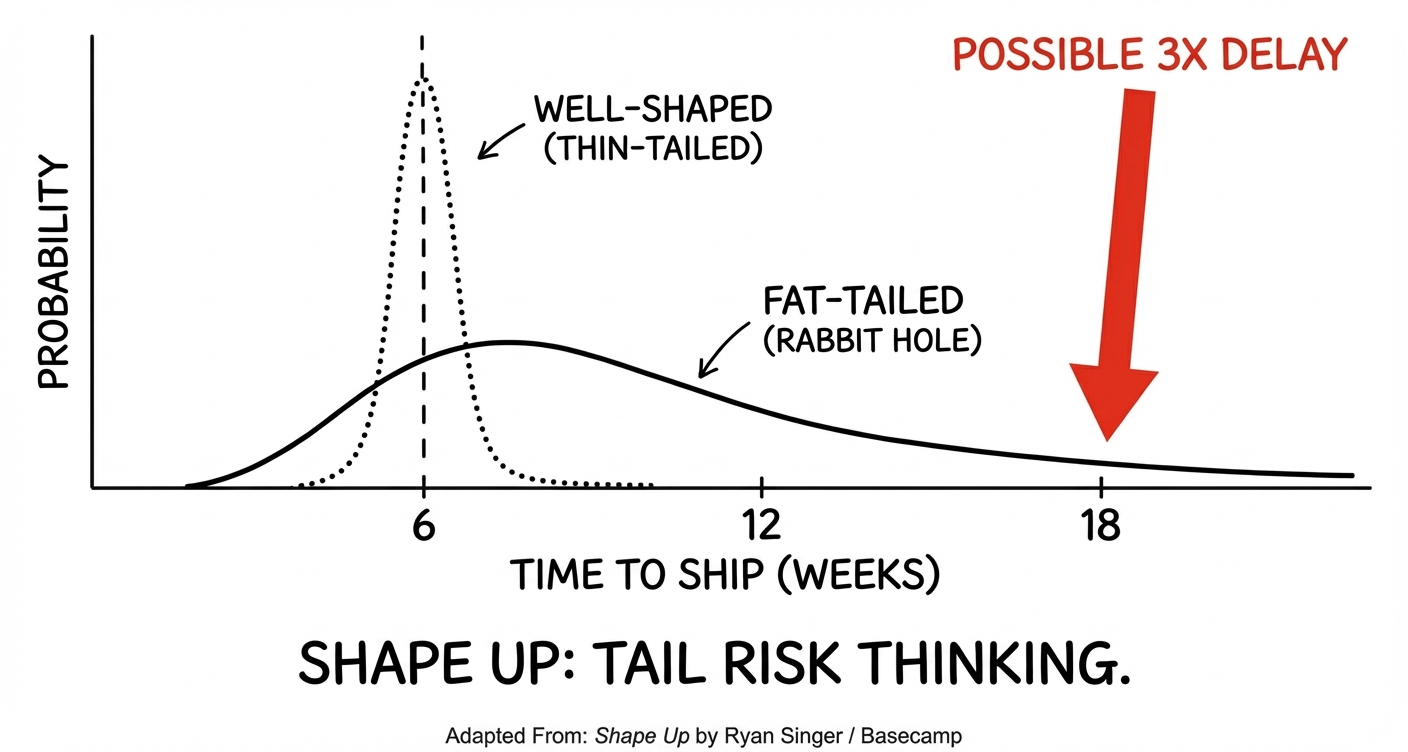
I adapted this chart from Ryan Singer’s book, Shape Up. It’s a mental model that immediately resonated with me because it visualises exactly what we mean by "de-risking”:
Think about it this way:
Every project sits somewhere on a probability distribution of delivery time.
The shape of the two curves tells you everything you need to know about your risk:
The Dotted Line (The Safe Bet)
This is familiar work. You’ve done it before, the dependencies are known, and the technology is proven.
When work sits on the Dotted Line, your distribution is tight and predictable. There is very little distance between your best-case and worst-case scenarios. You estimate 4 weeks, and you ship in 4 weeks. No drama.
Most teams assume their work lives here. Most teams are wrong.
The Solid Line (The Fat Tailed Bet)
Unlike the Dotted Line, the Solid Line has a Fat Tail—this is where the danger lives. The tail represents all the ways a 6-week build can become a 4-month ordeal. The shape of this curve is determined by the unknowns you haven’t addressed yet.
What creates a Fat Tail? It’s a taxonomy of rabbit holes:
Technical Unknowns: “We’ve never integrated with this system before, but it should be fine.”
Design Gaps: “We’ll figure out the edge cases during the build.”
Data Assumptions: “The data is probably clean enough.”
Dependency Risks: “That team said they’d have the API ready by then.”
Each of these is a landmine sitting in your plan, waiting for a developer to step on it mid-sprint.
The Red Arrow (The 3x Delay)
If the Fat Tail of the solid curve represents the possibility of a disaster, the Red Arrow points to a realised outcome in that distribution—a 6-week project that has spiralled into 18 weeks because of a single unaddressed unknown. As a result, a team burns through its entire budget solving a problem that should have been de-risked before the build even started.
This outcome is expensive in ways that go far beyond the calendar:
Morale Damage: Teams lose confidence when they feel “stuck,” and that frustration compounds across sprints.
Opportunity Cost: Every week spent in a rabbit hole is a week not spent on the next thing that matters.
Trust Erosion: Stakeholders start questioning every estimate, which leads to tighter controls and even worse planning.
→ The Goal of Shaping: Move the proposed solution from the Solid Line to the Dotted Line before the team commits to the build.
Same Project, Two Outcomes
Consider two different approaches to the same project:
Approach A: The Assumption-Led Build
The Plan: A 6-week build centred around a major third-party integration. The mocks are beautiful, stakeholders are aligned, and the team trusts the provider’s documentation.
The Trap: Four weeks into the build, a developer makes the first real connection and realises a critical technical requirement—something the entire feature relies on—isn’t actually supported by the vendor.
The Result: The team is now stuck. They spend weeks in “wait-and-see” mode, at the mercy of someone else’s roadmap. That 6-week project spirals into 18 weeks.
Approach B: The Discovery-Led Build
The Plan: Faced with the same integration, the lead runs a “Spike”—a time-boxed technical stress test. They quickly scaffold a dirty script to call the API and verify the data before the build starts.
The Reality: Because they used AI to handle the boilerplate, they find the technical gap within a couple of hours of investigation. Instead of committing to a broken plan, they pivot their approach or change the scope while they still have the flexibility to do so.
The Result: They set an honest, de-risked 8-week timeline. They ship in 8 weeks.
The difference between these two paths wasn’t better idealistic design. It was the willingness to look at the messy bits while the cost of changing course was still minimal.
How to Actually Thin the Tail
Thinning the tail isn’t a single activity. It’s a discipline applied during shaping that asks fundamentally different questions than most teams are used to.
Hunt for the “spiky” bits first: Don’t start with the “happy path”. Start with the parts of the solution that make you uncomfortable—the integration you’ve never done or the unfamiliar data model that feels “probably fine.”
Confront the spike: For every major unknown, run a technical stress test. Build the proof that the solution can be built. The goal is the elimination of technical uncertainty.
Use AI to accelerate the shaping: Don't solely use AI to churn out more feature code; use it to buy delivery certainty. If you can verify a solution in two hours instead of two days, you’ve removed the excuse for skipping discovery.
Involve the skeptics early: Find the expert who always finds the edge cases and get them in the room before you commit. You aren't looking for a pat on the back; you want them to challenge every assumption. Sometimes the best outcome is deciding not to build.
Define “done” by risk, not by polish: A shaped solution with rough sketches but zero technical unknowns is 10x more valuable than a high-fidelity mock full of assumptions. I only feel “done” when I can explain exactly how the messiest parts of the problem and solution fit together.
The Bottom Line
Shaping a solution is the discipline of trying to break your own plan while it’s still cheap to do so. It’s easy to obsess over the happy path solution, but the delivery outcome is decided in the messiest 20% of the build.
If you haven’t solved those bits before the team commits—even if you have a beautiful plan for the predictable parts—you aren’t managing a roadmap; you’re decorating a disaster.
De-risk reality instead of polishing an ideal.
Surface the traps early, and you give your team the one thing every roadmap needs: The confidence to actually ship.
Keep iterating,
— Rohan

→ Connect with me on LinkedIn or reach out via email.
Thanks for reading! Found value in this? Two ways to help:
Like, Comment, or Share - Help increase the reach of these ideas.
Subscribe for free - Receive my future posts direct to your inbox.